Changelog
The Press, The Community, and The Gap Between
671 brands. Editorial sources now indexed. What the data found this month.
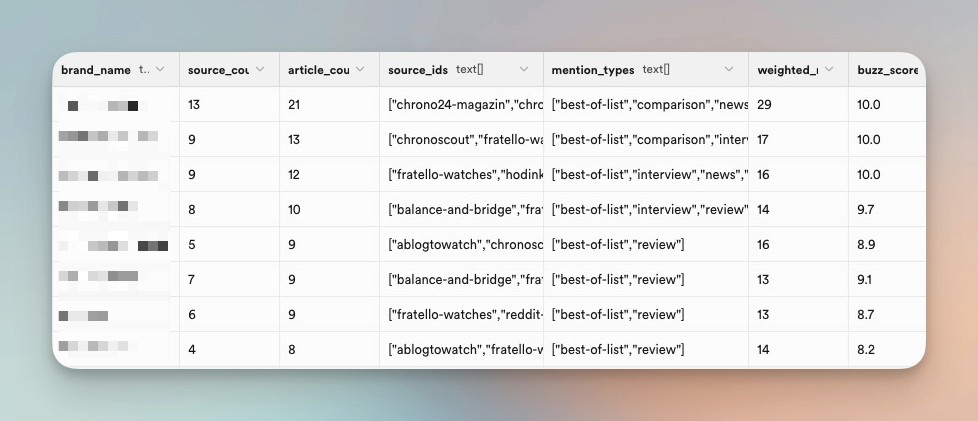
The database now reads the press. Hodinkee, Fratello, WatchTime, Monochrome, TimeandTide, Revolution, Worn & Wound, plus 23 further publications covering the watch market in English, German, French, and Italian. Each source is weighted by reach and editorial authority. A Fratello feature counts differently than a post on a 600-reader microblog. That difference is now in the score.
What the data found immediately: 61% of the 671 brands in the database have received zero editorial mentions in the last 90 days. Not one review. Not one roundup entry. They exist only through YouTube and Instagram, if at all.
The remaining 39% split into two clear patterns. The gap between them is visible for the first time.
Who is actually talking about you.
One Italian brand in the database has 23 YouTube reviews over 12 months. Strong collector traction. Sentiment score 0.79. Eight of those reviews compare it directly to Panerai. The brand does not use that comparison anywhere in its own communications. The collector community does, consistently, across eight independent channels.
Editorial coverage for the same brand: one Hodinkee mention, two Fratello references, nothing else. For a brand with that level of YouTube presence, the press gap is real. That combination, community-strong but press-invisible, is one of the most common patterns in the data.
What collectors actually say.
Comment analysis is now fully operational across all indexed reviews. The Italian brand example: top positive themes are design, heritage, and finishing quality. Top negative themes are strap quality (7 mentions) and delivery time (4 mentions). Most frequent phrase across all comment threads: "worth the wait." Second most frequent negative: "overpriced for the movement."
No brand monitoring tool would surface that combination. It comes from reading 23 videos worth of comment sections and pulling what repeats.
How Meta campaigns are actually built.
The Italian brand runs ad spend in concentrated bursts around launches, not as continuous background spend. Three weeks before a new reference: broad awareness push. Final five days: retargeting on warm audiences. Between launches: almost no activity. Targeting concentrated in IT, FR, DE, CH. 73% of budget in four markets.
Most brands in the same price range spread spend evenly across the calendar with no visible structure. The difference shows clearly in the efficiency data.
Where your audience actually lands.
One brand in the database reaches a primary demographic of male, 38–52. Secondary group: 45–60. No other brand in 671 comes close to that age profile. 74% of all active Meta spenders in the database target male, 25–34.
Do you know who your buyers actually are? While 74% of brands in this price range chase the 25-34 collector, this brand is reaching the 38-52 segment almost alone. That is the demographic with real purchasing power, the one that buys without waiting for a sale. Every other brand left that audience on the table. Whether this brand did it on purpose or by accident, the data does not say. But without that number, nobody ever asks the question.
Editor’s note:
Most Meta campaigns are not truly age-targeted. Advertisers often set broad parameters — for example Europe, male, and an age range such as 25–50 or even 18–65+. With automated delivery systems, the platform then distributes ads where engagement is highest. As a result, the commonly observed 25–34 audience often reflects algorithmic optimization rather than deliberate brand targeting. A campaign intentionally focused on the 38–52 segment therefore operates in a demographic space many competitors never explicitly address.
What is changing right now.
For the Italian brand: sentiment stable, Instagram up 11% over 60 days, YouTube coverage up three new reviews in the last 3 months, editorial mentions flat since Q4. The community is moving. The press is not following yet. That is either an opportunity or a signal that press outreach is missing entirely.
Across the broader database: five brands have had their reviewer language shift toward "entry-level" framing in the last 60 days. Two of them were mid-tier positioned twelve months ago. The shift in language came before any visible change in pricing or product.
Collector or mainstream.
Every brand sits somewhere between two poles. Deep collector focus, YouTube presence, editorial credibility, loyal audience on one side. Broad mainstream reach, high Meta spend, Instagram-first, thin community roots on the other.
61% of brands in the database have not chosen. They post, run some ads, and wait for a reviewer to find them. The ones with the clearest signal in the data, whether positive or negative, made a choice and kept to it.
Both directions work. They need different tools, different channels, different timing. Running both without a plan produces weak results on either side. The data shows where a brand currently stands. The decision stays with the brand.
What's New
Editorial sources indexed — 30 publications now tracked and weighted by tier. Includes Hodinkee, Fratello, WatchTime, Monochrome, TimeandTide, Revolution, Worn & Wound. Tier A weighted 5x over Tier C. Coverage score added to
v_brand_360Media strategy classification — brands tagged as YouTube-first, editorial-first, or mixed based on 90-day coverage distribution. 61% show no editorial coverage in that window
Publication weighting system — editorial mentions scored by publication tier. Full weighting table in database documentation
Comment analysis fully live —
comment_analysisJSONB populated across all indexed reviews with recurring themes, sentiment direction, and flagged keywords
Other Updates
YouTube comments processed under temporary-load, analyze-and-discard per DSGVO Art. 5(1)(c). Raw comment text and author data not written to the database
Brand count stable at 671. Focus this month on editorial source onboarding and data quality
lu_magazinestable now populated with all 30 indexed publications and weighting tiers
Fixes
Fixed editorial coverage score counting syndicated articles as separate entries
Resolved weighting calculation for publications with irregular publishing frequency
Changelog