Changelog
YouTube Intelligence Goes Live
Every watch review on YouTube. Every brand mention. Every signal, now structured.
The Instagram data told us how brands present themselves. What we needed next was what the collector community actually says about them — not in captions, but on camera, unprompted, in a full review.
That's what this update delivers.
We've mapped YouTube's watch review landscape and connected it to the database. Every channel that covers watches is tracked, from the large established reviewers to the smaller voices that focus almost entirely on microbrands. We take all of them. A 200-subscriber channel doing nothing but sub-$500 independents matters. The data doesn't filter by audience size.
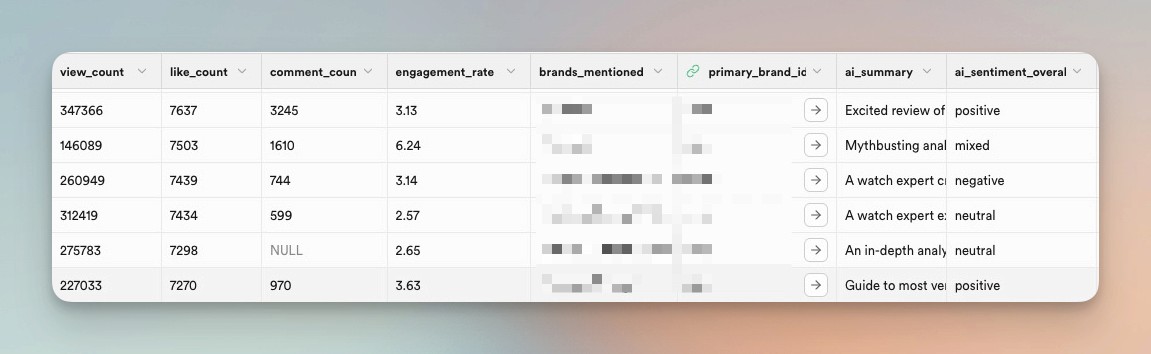
Every video gets transcribed and then processed by the enrichment pipeline. What comes back isn't a summary. The AI reads each review and extracts structured fields — the same fields, every time, for every brand mentioned. Here's what a processed segment looks like:
Every field comes from the transcript. Nothing is assumed. The improvement suggestions are what the reviewer said out loud. The USP is the phrase they actually used. The comparison brands are the ones they named.
When you have this for hundreds of reviews across hundreds of brands, patterns become visible. Which brands consistently get flagged as good value. Which ones keep getting compared to the same competitor. Which ones reviewers recommend but always follow with the same caveat.
That's what the database now holds.
What's New
YouTube channel mapping — watch-relevant channels identified and tracked across all tiers, including microbrand-focused reviewers
Full transcript indexing — every review transcribed and stored, searchable by brand name, model, keyword
AI enrichment pipeline — each review processed into structured fields:
reviewer_sentiment,ai_sentiment_price,ai_sentiment_quality,ai_recommendation,yt_usp,yt_pros,yt_cons,yt_who_is_it_for,yt_improvement_suggestions,yt_trend_reason,yt_compared_toBrand mention tagging — every transcript segment mapped to a
brand_idwith timestamp start and end, so the exact moment of mention is trackedBrand DNA signals live — seven-cluster JSONB scoring per segment:
craft_signature,origin_story,founder_story,trust_signal,heritage_revival,collector_psychology,category_gapai_microbrand_relevantflag — every video tagged automatically for microbrand relevance
Other Updates
Physical spec extraction added:
yt_case_size_mm,yt_movement,yt_dial_color,yt_crystal,yt_thickness_mm,yt_lug_to_lug_mmyt_compared_toarray tracks which competitor brands appear in the same reviewcomment_analysisJSONB field added to youtube_reviews for later useReviewer profiles stored with channel metadata and content focus
Fixes
Fixed brand name detection missing hyphenated names in transcripts
Resolved duplicate segment entries when a brand is mentioned multiple times in one video
Corrected sentiment scoring on short segments under 30 words
Fixed missing
brand_idon segments where a brand alias was used instead of primary name
Changelog